

California private schools are one of iModular’s top sources of new business. A growing enrollment, a new grade level, or a licensing requirement for more square footage per student can all turn into a space problem overnight — and a used HCD-approved modular classroom or admin building gets a school into usable space in weeks, not the years a new permanent building takes. This guide covers real classroom sizes, real costs, and the HCD approval path private schools actually go through in California.
Why private schools choose modular classrooms over new construction
Private schools in California sit outside the Division of the State Architect‘s (DSA) jurisdiction — DSA governs construction on public K-12 campuses only. Private school buildings are approved through the Department of Housing and Community Development (HCD) instead, a private-sector process that’s faster and more flexible than DSA: typically 4–8 weeks for plan check and approval in a cooperative jurisdiction, versus the multi-month DSA timeline public districts face for the same square footage. That difference is often the whole reason a private school can open a new classroom for the fall while a neighboring public school is still in plan check.
A used, HCD-approved classroom already sitting in inventory can be on site in weeks rather than months, since there’s no manufacturing lead time and, if it already carries a current insignia, no new plan check either. New construction remains the right call for a school’s forever building — but for a mid-year enrollment jump, a licensing-driven space requirement, or a bridge while a permanent building is designed, a modular classroom is usually the only option that fits the calendar.
Sizing a classroom or admin building for your enrollment
California classifies an instructional space as Group E occupancy, which uses a 20-square-foot-per-occupant net area factor to set the design capacity (CBC Table 1004.5). An admin or office building on the same campus is usually Group B instead, at 150 square feet per occupant gross — a much lighter load. The table below shows the sizes iModular quotes most often for private schools, with capacity estimated at the Group E classroom factor:
| Size | Square footage | Modules / trucks | Typical use | Transport class |
|---|---|---|---|---|
| 12′ × 40′ | 480 SF | 1 module / 1 truck | Small classroom or single office | Permit — no escort |
| 24′ × 40′ (standard classroom) | 960 SF | 2 modules / 2 trucks | Standard single classroom — up to 48 students at the Group E factor | Permit — no escort |
| 24′ × 60′ | 1,440 SF | 2 modules / 2 trucks | Larger classroom or open admin office | Permit — no escort |
| 36′ × 60′ | 2,160 SF | 3 modules / 3 trucks | Multi-room admin building | Permit — no escort |
All four sizes above use standard 12′-wide modules, which means an oversize transport permit but no pilot/escort car and no restricted travel window — the modules that carry an extra escort requirement are the less common 14′-wide units, which we’ll flag separately if your layout calls for the extra interior width. Foundations are typically our CP Pier System — a state-approved (California), powdercoated black, adjustable steel pier system rated for 100 mph wind loads and 100 lb snow loads — fast to install and easy to relocate if your campus plan changes later. Public-facing classroom and admin buildings default to an ADA ramp rather than stairs; see our California ADA ramp requirements guide for typical configurations and costs. For the full statewide size catalog, see modular building sizes in California.
Real private-school projects
iModular has delivered classroom buildings directly to California private schools and early-education centers. Desert Christian Academy worked with us on one 24′ × 60′ and two 24′ × 40′ classrooms during a permitting push to add instructional space. Saint Joseph’s Academy took delivery of a 24′ × 60′ classroom the same year. And Little Wings of Atascadero, a childcare center, had a 24′ × 60′ building remodeled, delivered, and installed with ADA ramping for its youngest students. These aren’t hypothetical layouts — they’re real schools that added real square footage on a real timeline, and each is available as a reference for prospective clients who want to hear about the process firsthand.

Buying a used public-school classroom? Here’s the DSA-to-HCD path
One of the fastest, lowest-cost ways for a private school to add space is buying a classroom a public school district no longer needs. The catch: that building was almost certainly approved under DSA, not HCD, and DSA-approved buildings can’t be occupied by a private school until they’re recertified into HCD’s jurisdiction. The good news is that DSA buildings are typically built to a higher structural standard than HCD requires, so a private school buying one is often getting a better-built classroom than a comparable new HCD unit — it just needs the paperwork to catch up to the building.
iModular runs this recertification process start to finish: pulling the existing DSA drawings and serial numbers, engaging a licensed engineer to prepare the HCD recertification package, submitting for plan check, coordinating the HCD inspection, and getting the new insignia installed. It typically takes 4–12 weeks depending on jurisdiction and how complete the original paperwork is. We cover the full process — including a real Riverside County example of a DSA classroom converted to HCD Group B — on our HCD inspection and recertification page. If you’re evaluating a used classroom from a public district, that’s the page to read next.
ADA access for school buildings
Any public-facing classroom or admin building — which covers nearly every building on a school campus — needs an ADA-compliant ramp, not stairs, as its primary entrance. California requires a maximum 1:12 slope, 36″ of clear width, and landings at the top, bottom, and any direction change; buildings with a higher finished floor height need a switchback ramp with intermediate landings. Costs typically range from about $8,000 for a simple low-rise ramp to $18,000–$30,000+ for a multi-switchback configuration on a taller unit. See our full California ADA ramp requirements guide for configuration examples and photos from real installations.
Financing a classroom on a school budget
Schools and nonprofits working within annual budget cycles are the textbook case for a lease-purchase arrangement — payments spread over time like a lease, but the school owns the building at the end of the term, through one of iModular’s third-party financing partners. An outright used-building purchase remains the fastest and lowest-total-cost path if the budget allows it. See our modular building financing options page for the full comparison of purchase, lease-purchase, and lease structures.
Frequently asked questions
Do private schools need DSA approval like public schools?
No. DSA governs construction on public K-12 campuses only. Private school buildings — including modular classrooms — go through HCD instead, which is a faster, private-sector approval process typically running 4–8 weeks in a cooperative jurisdiction.
Can our school buy a used classroom from a public school district?
Yes. This is a common, cost-effective way to add space. The building will need DSA-to-HCD recertification before your school can occupy it — a process iModular manages start to finish, typically in 4–12 weeks. See our HCD inspection and recertification page for the full process.
How fast can we get a classroom before the school year starts?
A stock unit already built and HCD-approved can often be delivered in as little as 2–6 weeks. A custom-built classroom typically takes 8–14 weeks to manufacture, plus plan check. Call early — availability on pre-approved stock units is first come, first served.
What size classroom do we need for our enrollment?
Group E classrooms use a 20-square-foot-per-occupant net area factor. A standard 24′ × 40′ classroom (960 SF) supports up to 48 students at that factor; a 24′ × 60′ (1,440 SF) supports more. Actual class size is also set by your program and staffing, not just the code maximum — tell us your enrollment and we’ll help you land on the right size.
Request a quote for your school
Tell us about your school’s space needs below — a new classroom, an admin building, or a used public-school classroom you’re considering — or call Matt Banes directly at (800) 806-7485.
iModular.com — California modular building specialists since 1998. Last updated: September 2026.
📞 Call (800) 806-7485 — Get a Price Now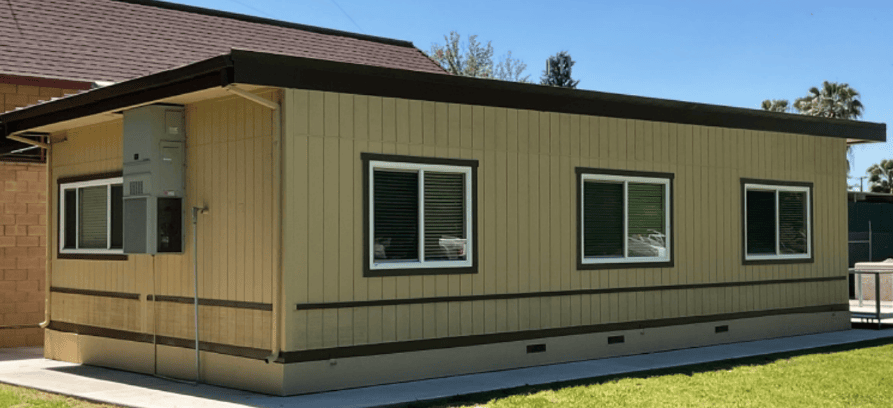


Leave a Comment