

Modular Building is a fast and affordable way to meet any type of temporary or permanent space needed for schools and businesses.
Any type of commercial or educational space can be in the form of a Modular Building complete with private offices, bathrooms, meeting areas, or whatever is needed to make your business or education facility comfortable for occupants.
One of the best features of renting or buying a Modular Building is that these structures are available in various sizes with all types of floor plan configurations. The purpose of a modular building is to provide a specific type of space quickly and affordably for a business, school, church, or any organization that needs to facilitate people in work, education, or living environments. Modular buildings can be delivered to a site, assembled, connected to utilities and technology, and made ready for occupancy within days of an order. Used and new modular buildings can be rented or purchased.
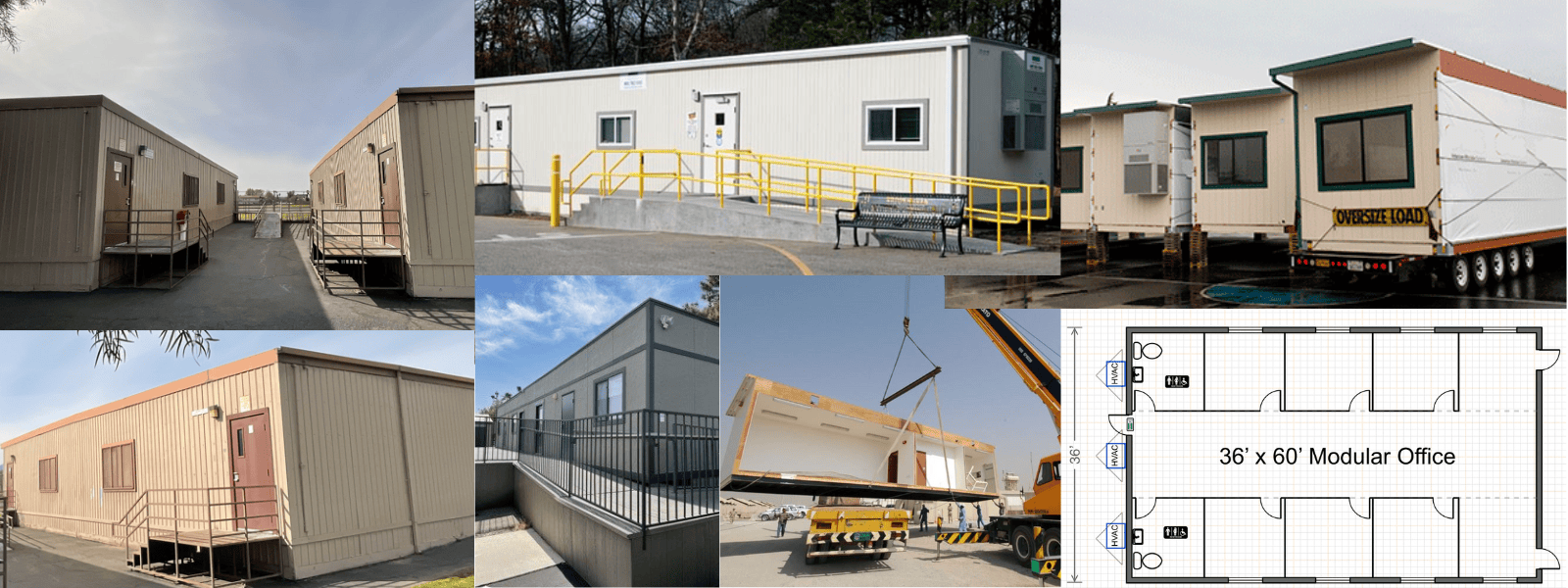
Photographs, Sizes, and Floor Plans of Modular Buildings


By definition, “modular building” is often explained as prefabricated modules built in a factory and delivered to a location where they are interconnected to create one large single or multiple-story structure. This process combines commercial and residential construction with a sophisticated method of building in a modern factory environment. The result is high-quality construction at an affordable price made ready for occupancy in half the time of conventional construction. You can learn more about modular building and the capabilities of the modular industry at the Modular Building Institute’s website.
What are the most common uses for modular buildings?
- Educational Facilities: Modular buildings are frequently used as temporary or permanent classrooms in schools, colleges, and universities, especially during renovation projects or to manage increasing student populations. In addition to classrooms, they are often used as science labs, locker rooms for athletic programs, after-school centers, and all types of educational facility office spaces.
- Construction Site Offices: These buildings provide essential office space for project management, meetings, and administrative work on construction sites.
- Healthcare Facilities: Modular buildings are used for clinics, patient wards, laboratories, and even temporary hospitals. They are particularly useful during health crises or when expanding existing healthcare infrastructure.
- Office Space for Businesses: They offer quick and flexible office solutions for businesses needing additional space, whether for temporary projects or permanent expansion. Any floor plan can be adapted to a business’s specific needs. For example, conference rooms, private offices, bathrooms, kitchens, and communications rooms can all be designed into a modular structure.
- Retail Outlets and Showrooms: Modular structures can serve as retail spaces, showrooms, or sales centers, especially useful for automobile, boat, or equipment dealerships.
- Government and Military Use: Government and military agencies use these buildings for various purposes, including as offices, barracks, training facilities, and disaster relief housing.
- Childcare and Daycare Centers: Modular buildings provide safe and customizable spaces for childcare services, including daycare centers and after-school programs.
- Religious and Community Centers: Religious organizations use them as worship spaces, community halls, or event centers.
- Event and Recreational Facilities: For events, festivals, or recreational activities, these buildings can serve as ticket offices, information centers, or clubhouses (like at golf courses).
- Industrial and Warehouse Needs: In industrial settings, they are used for additional storage, workshops, or as part of manufacturing processes.
- Emergency and Disaster Relief Housing: Modular buildings offer quick, efficient solutions for temporary housing and relief centers during natural disasters or emergencies.
- Remote Worksite Accommodation: For worksites in remote or temporary locations, such as mining or oil exploration sites, these structures provide living quarters, dining facilities, and recreational spaces.
What is a “standard” Modular Building, and what are some of the typical sizes available to rent or buy?
Some of the most common “standard” modular building sizes available for rent or purchase are 24′ x 40′ 960 square feet, 24′ x 60′ 1,440 square feet, 36′ x 60′ 2,160 square feet, 48′ x 60′ 2,880 square feet. Remember, any standard modular building can be customized to meet your specific floor plan needs much like renovating an office or home. Every floor plan is flexible.
Modular building manufacturers and dealers in the United States typically have “stock” modular buildings in their inventories. These standardized modular offices and classrooms are designed for the customer who needs space quickly and typically wants to rent the modular building for temporary use or buy a used model for a long-term need. This is similar to how some car dealerships have inventories of standard model cars – with higher-end custom options available through a special ordering process.
| Size | Approx. Square Feet | Common Uses | Estimated Occupants | Get a Price |
|---|---|---|---|---|
| 8′ x 20′ | 160 | Single office, construction site office | 1-2 | Get a Price |
| 8′ x 24′ | 192 | Small office space, security office | 1-2 | Get a Price |
| 8′ x 28′ | 224 | Extended small office, storage plus office | 2-3 | Get a Price |
| 8′ x 32′ | 256 | Larger office space, job site office | 2-3 | Get a Price |
| 10′ x 20′ | 200 | Small office space, meeting room | 2 | Get a Price |
| 10′ x 32′ | 320 | Medium office, multipurpose space | 3-4 | Get a Price |
| 10′ x 44′ | 440 | Large office, classroom, break room | 4-5 | Get a Price |
| 10′ x 52′ | 520 | Spacious office, large classroom, training room | 5-6 | Get a Price |
| 12′ x 44′ | 528 | Classroom, medium-sized office | 5-6 | Get a Price |
| 12′ x 60′ | 720 | Large office, classroom, medical office | 7-8 | Get a Price |
| 24′ x 40′ | 960 | Modular classroom, large office | 9-10 | Get a Price |
| 24′ x 60′ | 1440 | Double classroom, large office complex | 14-16 | Get a Price |
| 36′ x 60′ | 2160 | Temporary business space, large classroom, medical facility | 21-24 | Get a Price |
| 48′ x 60′ | 2880 | Large modular facility, assembly hall | 28-32 | Get a Price |
What is a custom Modular Building?
Custom modular building manufacturing is widespread in the United States. This prefabricated building option is designed to meet customers’ specific needs, particularly when a design specification needs to be exact for the operation of the business. Custom modular building manufacturing is popular for healthcare facility projects, public and private school campuses, military barracks and specialized military deployment structures, emergency response buildings and shelters, and any permanent single or multi-story commercial or residential structure
Today, architects, engineers, and building product manufacturers are more familiar than ever with customized modular buildings. This has opened many doors for modular builders to use a wider variety of stylish and functional interior and exterior finish materials, doors, windows, lighting, and building automation technologies that make Modular Buildings innovative and sustainable.
Do Modular Buildings have to meet state and federal building codes?
Yes. Commercial and residential modular buildings must meet the appropriate state and federal guidelines to be legally installed anywhere in the United States. This includes the Americans with Disabilities Act of 1990 and its regulations for providing handicap accessibility features to all public buildings. Check with your local Building and Safety Department or modular builder for details.
What types of foundations are available for Modular Building installations?
Modular Buildings can be installed on temporary or permanent foundation systems. These systems are professionally engineered to keep people safe while inside the structure under normal and abnormal circumstances, such as an earthquake or heavy wind event. The modular building supplier or installation contractor typically provides these systems, which can help you understand the different systems and requirements for obtaining a permit using one of the approved foundation systems for your area.
Temporary foundation systems typically consist of steel piers and either concrete or wood base pads. In areas where wind or seismic activity is common, tie-down strapping will also be required to strengthen the modular building’s connection to the ground.
Permanent foundation systems for modular buildings can be designed and engineered in many ways – all of which must meet local and federal building codes. Permanent modular buildings can be “pit set” into the ground or set above grade on a raised foundation. Permanent foundations are more costly than temporary systems, but they are well worth the investment if the modular structure is on-site for an extended period.
Who will deliver and install it once I buy or rent a Modular Building?
When you buy or rent a modular building, the supplier typically handles the delivery and installation. Most modular building companies either own transportation trucks or have contractors readily available for delivery and pick up. Additionally, modular building suppliers always have experienced and licensed installation contractors who can handle any type of temporary or permanent installation.