



Florida modular building certification runs through a state program, not your local building department. Before a commercial modular building, portable classroom, or modular office can be installed anywhere in Florida, it has to be approved by the Florida Department of Business and Professional Regulation (DBPR) and carry the state’s insignia. Here’s what that certification covers, what it leaves to your city or county, and when a used building needs to be recertified before it moves.
What Florida law calls a modular building
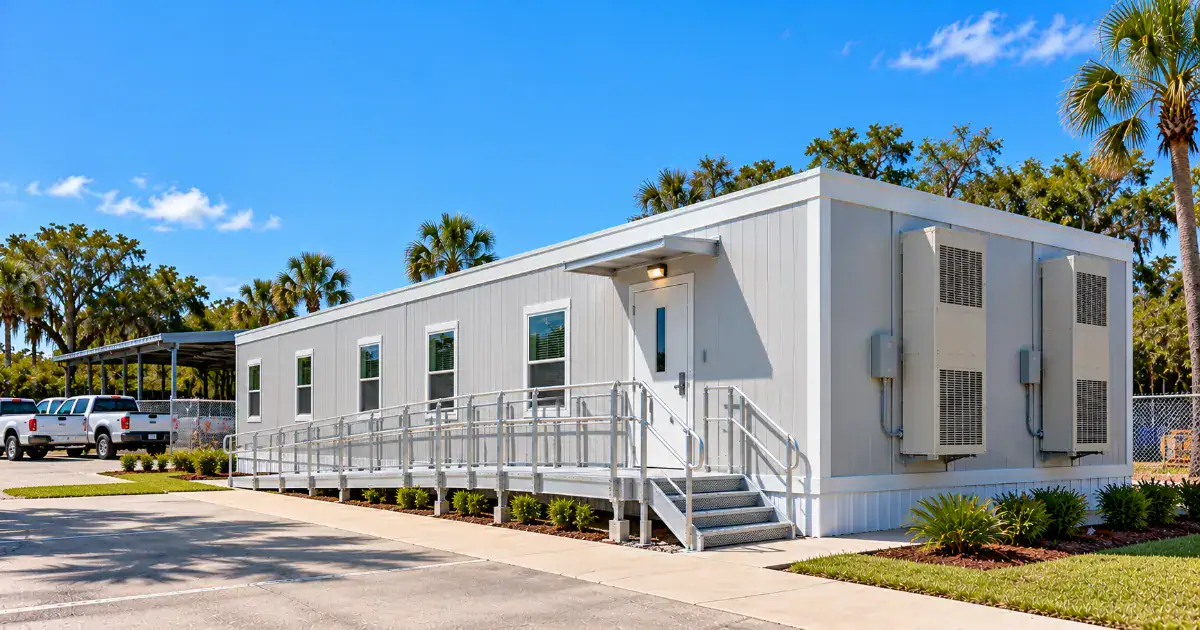
Florida’s statute uses the term “manufactured building” for what the rest of the industry calls a modular or relocatable building. Under Chapter 553, Part I of the Florida Statutes (the Florida Manufactured Building Act), that means a closed structure or building system built in a factory for installation as a finished building — residential, commercial, institutional, storage, or industrial. The same law states plainly that it does not apply to mobile homes built to the federal HUD code. So a 24′ x 60′ modular office and a HUD-code manufactured home are on two completely different regulatory tracks in Florida, even though the words sound alike.
How DBPR certification works
The Florida Building Commission sets the construction requirements inside the Florida Building Code, and DBPR runs the program day to day. The process has four parts:
- Manufacturer certification. A manufacturer must be certified by DBPR before it builds for Florida or sells into Florida. Certification lasts three years and can be revoked for code violations.
- Third-party plan review. DBPR sets the qualifications for approved third-party plan review and inspection agencies, which review the building’s plans against the Florida Building Code.
- Factory inspection. An approved inspection agency observes production at the plant, starting with the first building built, and keeps inspecting until the manufacturer’s quality control is proven.
- Insignia and data plate. An approved building gets the DBPR insignia plus a manufacturer’s data plate. Under s. 553.37(3), a manufactured building generally can’t be installed in Florida without them.

If you’ve bought modular in another state, this is Florida’s counterpart to programs like Texas’s TDLR Industrialized Housing and Buildings program — same idea, Florida’s own rules.
What the insignia means for your local permit
This is the part most buyers miss. A building that carries the DBPR insignia is deemed to comply with the Florida Building Code and is exempt from local code amendments. Your city or county doesn’t re-approve or re-label what’s “inside the box.”
What the local building department still controls is everything outside it. Florida law reserves land use, zoning, setbacks, property lines, and on-site installation requirements entirely to local authorities. That means the foundation, tie-downs, utility hookups, ramps, and site work are permitted and inspected locally — and the local government has to apply the same reasonable standards it would to a site-built building. It can’t charge more in permit fees for a modular building than for comparable conventional construction.
Used buildings: when Florida requires recertification
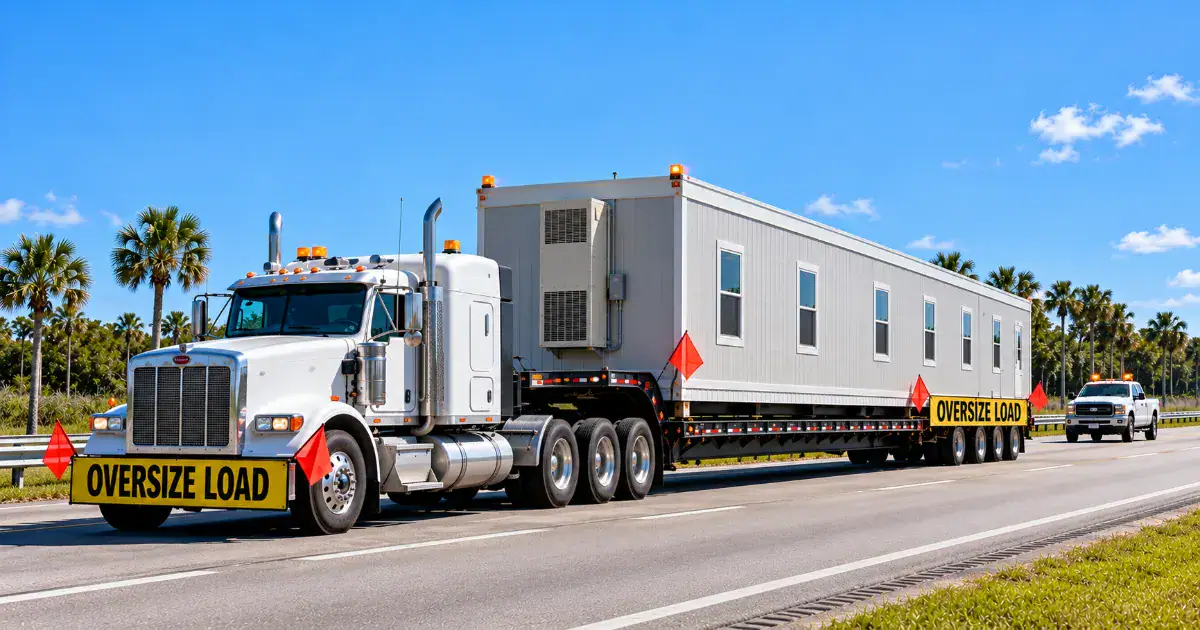
If you’re buying a used modular building, check this before you sign. Under s. 553.375, a building may need state recertification before it is:
- moved to a site with a higher design wind speed than it was built for,
- modified, or
- put to a new occupancy (for example, an office converted to a classroom).
The owner can choose state recertification, or instead go through local permitting and get a certificate of occupancy from the local building official. In a state where wind design speeds change sharply between inland counties and the coast, the data plate’s design wind speed matters as much as the floor plan. That’s consistent with the national picture: the 2024 International Building Code updated wind and snow load maps nationwide through ASCE 7-22, so older relocatable units may not meet new site conditions without upgrades, according to the Modular Building Institute’s 2026 Annual Report.
Florida public school classrooms have an additional layer. Factory-built school buildings are covered by their own section of the statute (s. 553.415), and an existing building without the required label may not be used as a classroom. Private schools and churches should still confirm occupancy requirements with their local building official early.
How iModular.com helps on Florida projects
iModular.com brokers modular buildings nationwide, including Florida. Our role is to source and qualify the building, scope the project, flag certification and wind-zone issues early, and broker the right building for your site. See the Florida modular building prices page for how that works, or the Florida private schools and Florida churches guides for project-type detail.
Always confirm current requirements with DBPR and your local building department before finalizing a project. Statute and rule details can change between legislative sessions.
Frequently asked questions
Who certifies modular buildings in Florida?
The Florida Department of Business and Professional Regulation (DBPR) runs the state’s manufactured building program. Approved third-party agencies review plans and inspect at the factory, and approved buildings carry a DBPR insignia and a manufacturer’s data plate.
Is a Florida “manufactured building” the same as a mobile home?
No. Florida’s manufactured building law covers factory-built modular buildings and specifically excludes mobile homes built to the federal HUD code, which follow a separate set of rules.
Does my city or county have to approve a DBPR-certified building?
Not the building itself. A building with the state insignia is deemed to comply with the Florida Building Code. Your local government still permits and inspects zoning, setbacks, the foundation, tie-downs, utilities, and other on-site installation work.
Does a used modular building need recertification to move in Florida?
It can. Under s. 553.375, recertification may be needed before a building is moved to a site with a higher design wind speed, modified, or given a new occupancy. The alternative is local permitting and a certificate of occupancy from the local building official.
Does iModular.com broker modular buildings in Florida?
Yes. iModular.com brokers modular buildings nationwide, including Florida. Call Matt at (800) 806-7485 to talk through your project.
Written by Matt Banes, iModular.com President, 38 years in the modular building industry. Last updated: October 2026.

Leave a Comment