

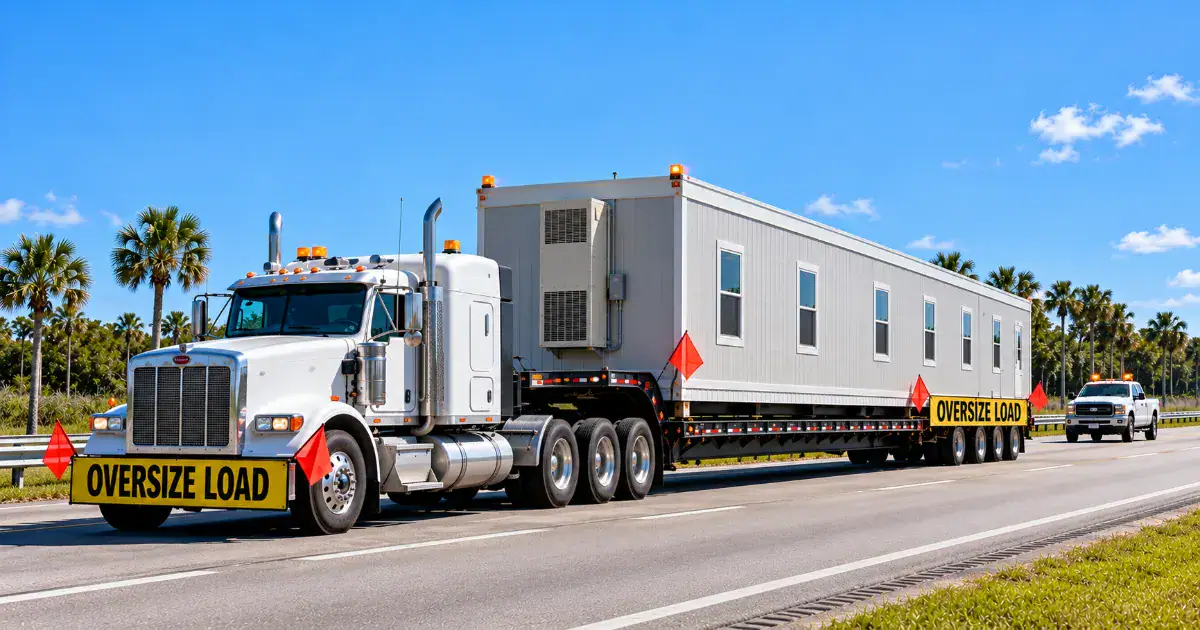

Almost every modular building is wider than a normal truckload, so Florida modular building transport permits are part of every delivery and every relocation. The Florida Department of Transportation (FDOT) issues oversize permits for state roads, and Florida’s rules spell out when an escort vehicle is required, what warning lights a modular load needs, and when it can travel. Here’s what buyers should know before a building moves.
Why modular buildings need an oversize permit
Under s. 316.515 of the Florida Statutes, a vehicle and its load generally can’t be wider than 102 inches (8 feet 6 inches). A standard modular module is about 12 feet wide, so each module travels on its own oversize permit. A 24′ x 60′ double-wide is two modules, which usually means two loads and two permits.
FDOT’s State Permit Office handles oversize and overweight permits for state-maintained roads through its online Permit Application System. FDOT notes that oversize permits have to be in place before a load enters Florida, which matters if your building is coming from out of state. City and county roads can have their own requirements.
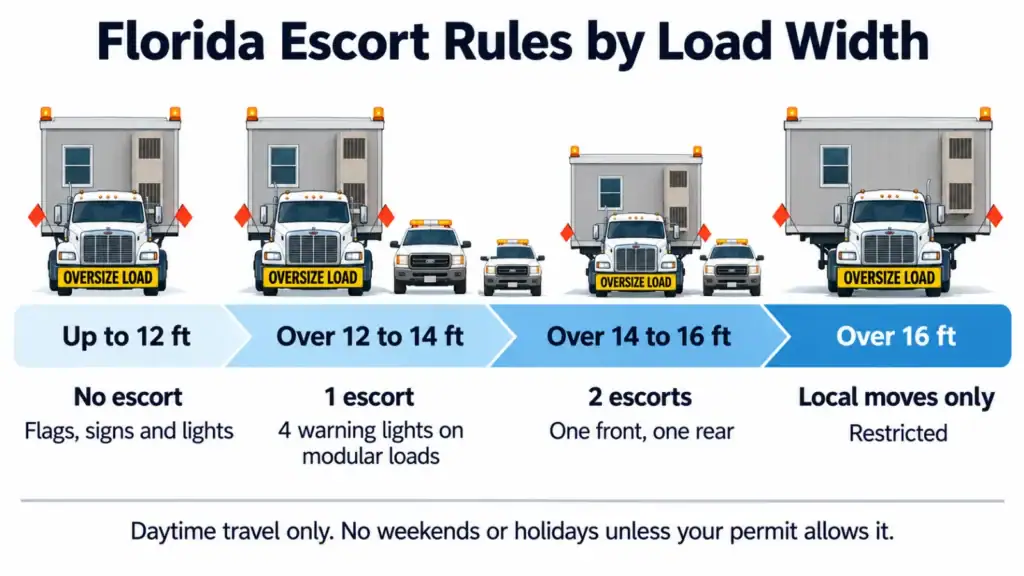
Florida escort rules by load width
Florida’s movement rules for permitted loads are in Rule 14-26.012 of the Florida Administrative Code. In summary:
| Load width | Escort requirement | Travel |
|---|---|---|
| Over 8′6″ to 10′ | No escort; flags required | Daytime |
| Over 10′ to 12′ | No escort; flags, warning signs, and lights | Daytime, no holidays |
| Over 12′ to 14′ | At least one escort at all times; two on some narrow, bridge, or high-traffic routes unless the load has four warning lights | Daytime, no holidays |
| Over 14′ to 16′ | Two escorts, one front and one rear | Daytime, no holidays |
| Over 16′ | Local moves only, with escort requirements set by road type | Restricted |
A few details apply specifically to modular loads:
- Four warning lights. Modular buildings, manufactured buildings, and similar loads over 12 feet wide need at least four warning lights, one at each corner of the unit.
- 16-foot maximum width for manufactured buildings.
- 80-foot maximum for sections of a manufactured building on a trailer, the same limit s. 316.515 sets for FDOT’s special permit for manufactured buildings.
- When loads move. Permitted loads generally can’t move on weekends or holidays unless the permit allows it, can’t move in congested areas during rush hour, and can’t move when visibility is under 1,000 feet.
Measure the module itself, including roof overhangs and trim, not just the box. Overhangs can push a 12-foot module into the next width band and add an escort. Your permit sets the final conditions for each load, so always follow the permit.
Check certification before the building moves
A transport permit gets the building down the road. It doesn’t make the building legal at the new site. If the new site has a higher design wind speed than the building was built for, or the building will be modified or used for a different occupancy, Florida law may require recertification (s. 553.375 of the Florida Statutes), or local permitting and a certificate of occupancy instead. Our Florida modular building certification guide explains it.
Check the data plate before you pay for transport, not after the building arrives.
How iModular.com helps
iModular.com brokers modular buildings nationwide, including Florida. We source and qualify the building, check its data plate against your site, and broker the right building for you. Moving a job-site office? See our Florida construction office guide. Replacing storm-damaged space? See Florida disaster response modular buildings.
Requirements can change, so confirm current rules with FDOT and your installer before any move.
Frequently asked questions
Do I need a permit to move a modular building in Florida?
Almost always. Florida’s legal width limit is 102 inches (8 feet 6 inches), and most modular modules are about 12 feet wide, so each module needs an FDOT oversize permit for state roads. Local roads may have their own requirements.
When does a modular building load need an escort in Florida?
Under Rule 14-26.012, loads over 12 feet wide need at least one escort, and loads over 14 feet up to 16 feet need two, one in front and one behind. Loads 12 feet wide or less don’t need an escort but need flags, signs, and lights.
Can modular buildings move on weekends in Florida?
Generally no. Permitted oversize loads are restricted to daytime travel and can’t move on weekends or holidays unless the permit says otherwise. Rush-hour moves in congested areas are also restricted.
Does a used building need recertification before it moves to a new Florida site?
It might. If the new site has a higher design wind speed, or the building will be modified or used differently, Florida may require recertification under s. 553.375, or local permitting and a certificate of occupancy instead.
Does iModular.com broker modular buildings in Florida?
Yes. iModular.com brokers modular buildings nationwide, including Florida. Call Matt at (800) 806-7485 to talk through your project.
Written by Matt Banes, iModular.com President, 38 years in the modular building industry. Last updated: October 2026.

Leave a Comment