


Anywhere from a few days to a few months. That is the honest answer, and the spread is not about the building — it is about permitting, what is available near you, your site, your utilities, whether there is plumbing, and the weather. A used building that already exists, sits within trucking distance and needs no plumbing can be on your site in days. A new building designed from scratch for a complicated site takes months. Call (800) 806-7485 with your situation and you will get a real date, not a brochure number.
The four speeds of a modular building
| Path | Realistic timeline | What makes it possible |
|---|---|---|
| Used building, ready to go | Days to a few weeks | The unit exists, is close enough to truck, needs no plumbing, and your site and permits are ready |
| Used building needing refurb or conversion | Several weeks to a few months | Remodel, re-skin, code conversion or recertification before it ships |
| New building, standard sizes | Design 2–6 weeks, manufacturing 4–12 weeks, plus site work | Factory build runs while site work and permitting run in parallel |
| Large multi-module complex | Months | 36 recent US and Canadian projects averaging 12,789 sq ft and 29 modules took 158 days on average (Modular Building Institute, 2026 Annual Report) |
Modular is still materially faster than site-built construction for the same square footage, because the factory work and the site work happen at the same time instead of one after the other. But a schedule is only as fast as its slowest dependency, and that dependency is almost never the factory.
What actually sets your timeline
1. Whether a building like yours exists right now
A 24×40 classroom is a common size, so used ones come available regularly — but “available” has to mean available near you. Industry-wide fleet utilization ran 71.4% in 2025 (Modular Building Institute, 2026 Annual Report), so idle units do exist, just not always the size you want in the state you want it. Sourcing is the part we do for you, and the faster answer is often a building 300 miles away that nobody has listed yet.
2. Permitting and state approval
This is the single biggest variable, and it is entirely outside the factory’s control. Commercial modular buildings are approved through a state program — HCD in California, TDLR in Texas, DBPR in Florida, and an equivalent in most other states — and then permitted locally for foundation, utilities and occupancy. Some jurisdictions turn a modular permit around quickly because the building is pre-engineered and already state-approved. Others take months regardless of what you bought. Start this the week you start shopping, not after the building is ordered.
3. Plumbing, or no plumbing
A building with restrooms is a different project from one without. Plumbing brings sewer or septic connection, water service, underfloor work and its own inspections — each with its own scheduling and sign-off. If your use can live with restrooms in an adjacent building, you can often cut weeks out of the schedule.
4. Utility connections
Power is frequently the quiet delay. Panel capacity, a new service drop, trenching, data and fire-alarm tie-ins all run on the utility’s calendar, not yours. Temporary power can bridge the gap on a job site; a classroom that needs permanent service cannot open until the utility shows up.
5. Site conditions and access
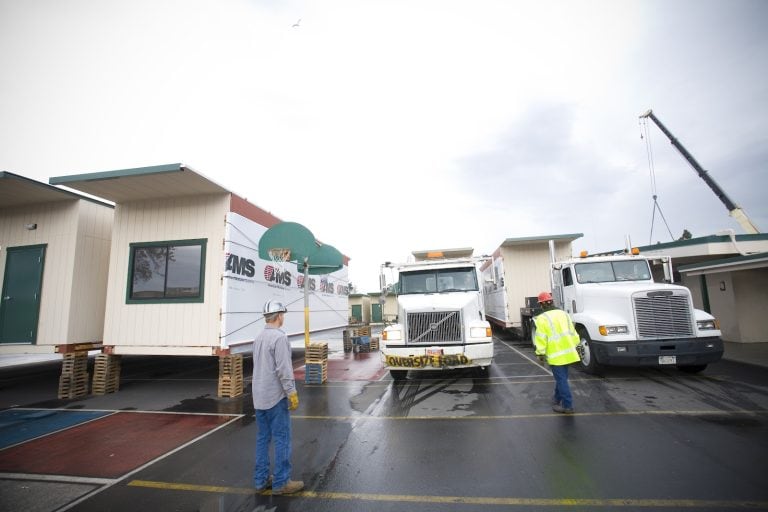
Grade, soil, paving, drainage and truck access all move the date. A 24×40 arrives as two 12-foot-wide modules on two trucks, a 12-foot-wide load is a permit load that needs escorts in most states, and a tight turn radius, a low wire or a narrow gate can change the delivery plan entirely. Foundations — typically an adjustable steel pier system rather than a concrete pour — go in fast once the pad is right, but getting the pad right can take longer than the building.
6. Weather
Rain stops site work, soft ground stops cranes and toters, and seasonal road restrictions limit oversize transport in parts of the country. Factory production keeps running in bad weather — that is one of modular’s real advantages — but set day still needs a workable site.
7. Whether it is an emergency
Fires, floods, storm damage, a failed building, a sudden enrollment jump — emergencies genuinely move faster. Jurisdictions expedite, suppliers release units they were holding, and the whole chain compresses. If you are in one, say so on the first call; it changes what we go looking for and how everything gets sequenced.
How to compress the schedule
- Start permitting immediately. You can open the conversation with your building department before you own a building. It is the longest pole and the earliest one you can start.
- Stay flexible on the building. A buyer who will take a 24×40 in any reasonable condition gets a building far sooner than one who needs a specific size, age and finish.
- Do site work in parallel. Pad, utilities and ramps can all progress while the building is being refurbished or manufactured.
- Skip plumbing if the use allows. Offices, classrooms and admin space often can, and it removes an entire inspection track.
- Answer the access questions early. Photos of the gate, the approach and the pad location tell us on day one whether delivery is simple or complicated.
What this looks like in practice
San Gabriel County Water District in Rosemead needed office space and got a remodeled and converted 24×40 with a handicap access ramp. Green Lawn Funeral Home in Bakersfield took delivery of a remodeled 36×40 classroom and office building. Little Wings of Atascadero needed a 24×60 childcare building with ramping. Each had a different timeline, and in every case the building itself was not the part that set the date.
Get a real date for your project
Tell us the size, the use, the location, whether it needs plumbing, and the date you need to be in it — by phone at (800) 806-7485 or through the nationwide contact form. iModular brokers directly in California and sources buildings nationwide, connecting you with a supplier and installer in your state. Related reading: buying used buildings, permits and codes, and installation.
Frequently asked questions
How fast can I get a portable classroom?
If a suitable used classroom is available within trucking distance, your site is ready and permits are in hand, days to a few weeks. If it needs conversion or recertification for a different use, add weeks to months.
What takes the longest?
Permitting and utility connections, almost every time. The factory and the trucking are the predictable parts.
Can I really get a building in a few days?
It happens — when the unit already exists nearby, needs no plumbing, the site is prepared and the jurisdiction moves quickly. It is not the normal case, and anyone who promises it before seeing your site and permit situation is guessing.
Does plumbing really slow it down that much?
Yes. Restrooms add sewer or septic, water service, underfloor work and separate inspections. It is one of the biggest schedule forks in the whole project.
What if this is an emergency?
Say so immediately. Emergency replacements after a fire, flood or building failure move faster at every step — sourcing, permitting and delivery — and we look for different buildings than we would for a planned project.
How long does a brand-new modular building take?
Budget roughly 2–6 weeks of design and 4–12 weeks of manufacturing, running alongside your site work and permitting. Larger multi-module complexes average around 158 days end to end, per the Modular Building Institute’s 2026 Annual Report.
Is modular actually faster than conventional construction?
For comparable square footage, yes — mainly because factory production and site preparation happen simultaneously instead of sequentially, and factory work is not weather-dependent.
iModular.com — modular building specialists since 1998, brokering directly in California and sourcing nationwide. Written by Matt Banes, 38 years in the modular building industry. Last updated: September 2026.