

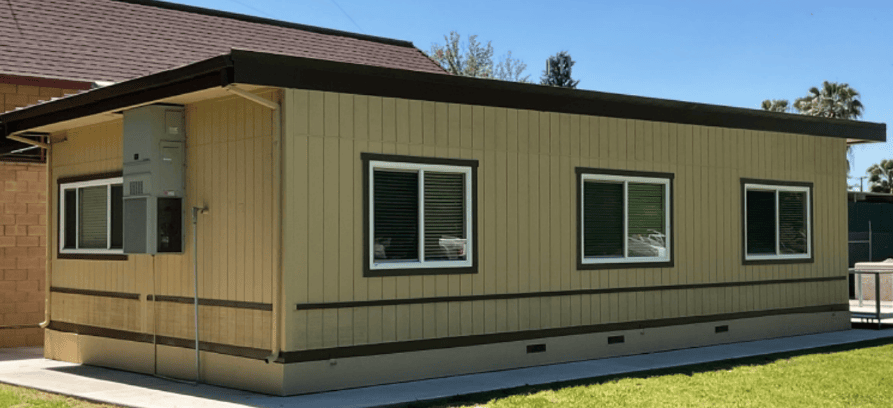

Quick answer: An HCD inspection for used modular buildings is required in California whenever a unit has no current HCD insignia — a Technical Service inspection (Title 25 CCR §4014) before title can transfer or a new insignia can be issued. HCD verifies the chassis plate and serial number, confirms the box size, and inspects electrical, plumbing, and life-safety systems — a published, fixed-fee process (about $289 all-in for a typical one-hour inspection) that most units clear in days to a few weeks.
If you’re buying a used commercial modular building in California and it doesn’t carry a current HCD insignia, the state has to inspect and identify the unit before title can transfer or a new insignia can be issued. Here’s what that inspection actually involves, what it costs, and where it fits in your project timeline — based on inspections iModular coordinates directly with HCD’s Area Offices.
Why an HCD Inspection for Used Modular Buildings Starts With No Insignia on File
Every commercial modular legally placed in California carries an HCD insignia — a metal tag, similar to a HUD label on a manufactured home, confirming the state has a record of the unit and approved it. Buildings turn up without one for a few ordinary reasons: the insignia plate corroded off after decades outdoors, the paperwork was never filed the last time the building changed hands, or the unit came out of an out-of-state factory or a private surplus sale that never went through California’s registration process to begin with.
None of that means the building is unsafe or unusable. It means California doesn’t yet have a record of it — and a record has to be created before you can legally take title or place it for occupied use.
What an HCD Inspection for Used Modular Buildings Actually Checks
When HCD has no record of an insignia ever being issued, the state requires what’s formally a Technical Service inspection under Title 25 of the California Code of Regulations, §4014 — labeled “MHO-TS” on HCD’s own paperwork. An HCD Departmental Representative–Inspector visits the unit, at the yard or on site, and:
- Records the manufacturer’s chassis plate, serial number, and model/year wherever they’re stamped or riveted to the frame
- Measures and confirms the box size and configuration — single-wide, double-wide, number of sections
- Photographs the plate and the exterior of every section
- Checks the unit’s electrical, plumbing, heat-producing, fire, and life-safety systems and equipment for code compliance
The inspector then issues an Activity Report (HCD form CS 61) documenting what was found. If everything checks out, the report is marked “Inspection Record Only,” violations are logged at zero, and HCD closes the file — no reinspection required. That report becomes the state’s official identification record for the unit going forward.

What an HCD Inspection for Used Modular Buildings Costs and How Long It Takes
An HCD inspection for used modular buildings follows a fixed, published fee schedule set by HCD — not something negotiated case by case:
| Item | Fee |
|---|---|
| New insignia fee (mobilehome / commercial modular) | $51 |
| Minimum inspection fee (first hour) | $238 |
| Each additional inspection hour | $109 |
| Each additional half-hour | $51 |
Most single-unit inspections run about an hour, matching HCD’s own minimum billing increment — so a typical unit clears for close to $289 all-in. The applicant — typically iModular, on behalf of the buyer — files Form HCD MH 415 through HCD’s Codes and Standards Online Services portal or by mail to the regional Area Office, pays the fee, and HCD schedules the visit. Commercial modulars additionally require a written certification from a California-licensed engineer or architect confirming the structural and thermal systems comply — one more reason iModular keeps engineering packages on file for every used unit it sources.
If the inspector finds a problem
Not every inspection closes clean. If HCD documents violations, the report becomes a formal Notice of Violation instead of an information-only record, and it specifies a correction period and a paid reinspection before the file can close. That’s exactly why iModular has a unit inspected — and any corrective work done — before it goes to a buyer, not after: it’s far cheaper and faster to fix an item in the yard than to discover it mid-title-transfer with a move-in date already on the calendar.
Identification inspection vs. DSA-to-HCD recertification — not the same process
An HCD inspection for used modular buildings and a DSA-to-HCD recertification get confused often enough to spell out plainly:

| Identification inspection (this article) | DSA-to-HCD recertification | |
|---|---|---|
| Starting point | Building has no HCD record at all | Building was already approved — under DSA, for a public school |
| What HCD is doing | Confirming what the unit is and that its systems are code-compliant, then issuing a first insignia | Converting an existing public-school approval to private-sector HCD jurisdiction |
| Paperwork | Form HCD MH 415 + Technical Service inspection | Full engineering package + HCD plan check |
| Typical cost | $238–$400 range for a straightforward unit | $3,500–$8,000, depending on complexity |
| Typical timeline | Days to a few weeks to schedule and close | 4–12 weeks for plan check |
iModular has run both processes. On one project — converting a 24′ × 40′ Portable Classroom, originally approved under DSA for a public school, into a Group B office for a private client in Riverside County — the recertification path took a full engineering resubmittal and a Conditional Use Permit before HCD would sign off. An identification inspection on a unit that’s already code-compliant is a much shorter conversation.
A recent example
iModular recently coordinated Technical Service inspections for a Southern California church acquiring a three-section 36′ × 40′ Portable Classroom. None of the three sections carried a California insignia, so each was scheduled individually with HCD’s Southern Area Office. The inspector documented the chassis plate and serial number on each section, confirmed the box dimensions, and found zero violations across all three — HCD closed every file the same day, no reinspection required. That inspection record is now part of the paperwork clearing the way for title to transfer.
That’s the outcome you want: a clean report that becomes a routine part of the file — not a surprise that shows up during delivery week.
What this means if you’re buying used
If you’re evaluating a used modular building and the seller can’t produce a current HCD insignia, that’s not automatically a red flag — it’s a known, well-defined process with a published fee schedule and a state agency that handles it routinely. What matters is who’s managing it and when. Before you sign, ask your seller three things: has the unit’s HCD status actually been verified, is an identification inspection already scheduled or completed, and is that cost built into the price or left for you to arrange separately. iModular verifies insignia status on every used building it sources and, where needed, schedules the Technical Service inspection before the unit goes under contract — so it isn’t a step you’re managing yourself against a move-in deadline. If you’re planning to convert the building once its paperwork clears — into office space, for example — see our guide on converting a portable classroom into an office.
Frequently asked questions
What is an HCD insignia?
It’s a metal tag HCD issues to a manufactured home, mobilehome, or commercial modular once the state has approved it — the modular-building equivalent of a HUD label. It’s proof the unit is on record with California and cleared for its approved use.
What does HCD check during an identification inspection?
The chassis plate, serial number, and model information; the box size and configuration; and the condition of the electrical, plumbing, heat-producing, fire, and life-safety systems.
How much does it cost?
HCD’s published schedule: $51 for the new insignia, plus a $238 minimum inspection fee for the first hour ($109 for each additional hour, $51 per half-hour). Most single-unit inspections fall near the one-hour minimum — about $289 total.
How long does the whole process take?
Scheduling and closing a straightforward inspection typically runs days to a few weeks, depending on the HCD Area Office’s workload — much faster than a DSA-to-HCD recertification, which involves a full plan check.
Is this the same as recertifying a DSA building?
No. An identification inspection establishes HCD’s first record of a unit that has none. DSA-to-HCD recertification converts an existing public-school approval to private-sector use and requires a full engineering and plan-check package.
What happens if the inspector finds a violation?
The report becomes a Notice of Violation instead of an information-only record. It specifies what needs correcting and requires a paid reinspection before the file closes.
Buying a used modular building in California? iModular verifies HCD status before you sign, and manages the identification inspection when a unit needs one — so it’s handled before your delivery date, not during it. Call (800) 806-7485 or request a quote at iModular.com.
Do I still need a local building permit, separate from the HCD inspection?
Yes. The HCD inspection above only applies when a used building is missing its insignia. Installing any HCD modular building in California, new or used, still requires a separate permit from your local city or county Building & Safety Department for site work, utility connections, and ADA access routes.
Who handles the local permit process?
The property owner or their contractor is typically responsible for submitting plans and securing the permit, including the site plan, utility connections, and accessibility compliance. iModular handles the HCD side of a used-building purchase; local permitting is a separate step your contractor or design team manages.
What documents does the local permit application need?
Typically the HCD insignia number, foundation plans, a site plan, utility connection details, and ADA access routes. Requirements vary by city and county, so confirm the exact list with your local Building & Safety Department before submitting.
How long does the local permit process take?
Local permit approval typically runs 12–24 weeks from submission, depending on the jurisdiction — separate from, and in addition to, the HCD identification inspection timeline covered above.
Request your HCD inspection or recertification
Tell us about your building below and we’ll get you routed to the right process — whether that’s a straightforward HCD inspection or a full DSA-to-HCD recertification — or call Matt Banes directly at (800) 806-7485.
📞 Call (800) 806-7485 — Get a Price Now