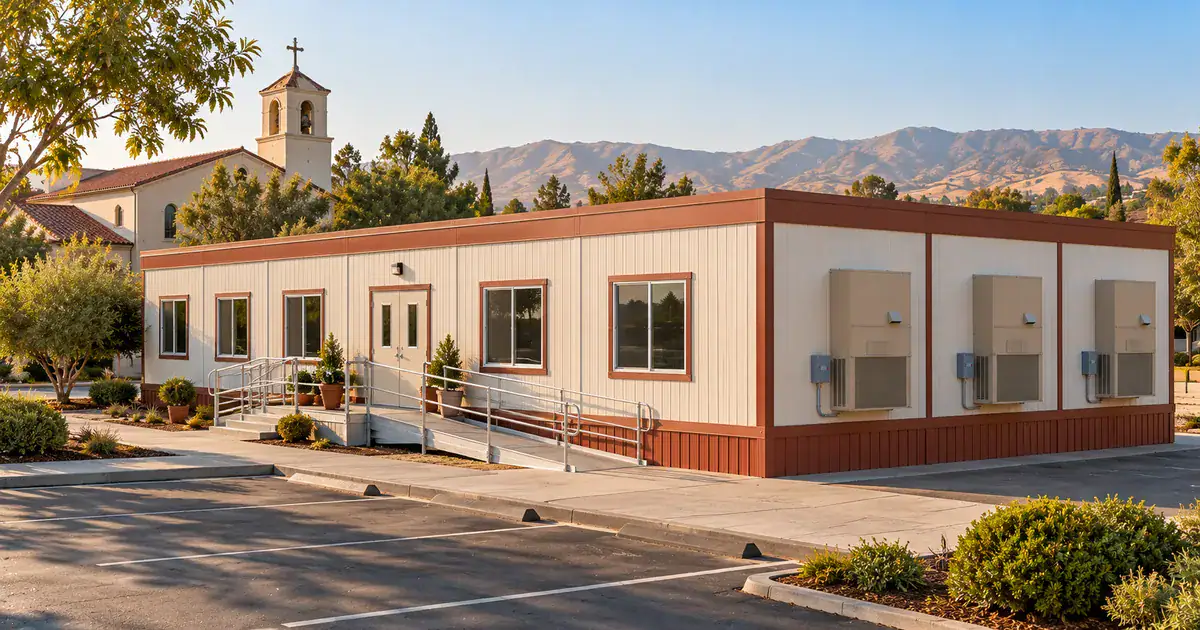

Two modular buildings can be the exact same size and still go through completely different permitting — because in California, occupancy classification is driven by how the building is used, not the fact that it’s modular. A classroom, an office trailer, and a church meeting hall all get reviewed under different rules, with different timelines and different costs. Understanding modular building occupancy classifications early keeps your permitting timeline on track.
Why modular building occupancy classifications matter more than square footage
The California Building Code (CBC) assigns every building — modular or permanent — to an occupancy group based on its use. That classification drives the number of required exits, fire alarm and sprinkler requirements, accessibility features, plumbing fixture counts, and how far occupants can travel to an exit. It also determines which state authority reviews the project: HCD for private schools, churches, and commercial buyers, or DSA for public K-12 campuses. Get the occupancy type wrong during planning and the permitting timeline — and the budget — can shift by months.
The modular building occupancy classifications you’ll actually run into
Group E — Educational
Applies to any space where six or more students receive instruction through 12th grade — portable classrooms, double classrooms, and school admin buildings when used for instruction. Group E carries the strictest life-safety, exiting, fire alarm, and accessibility requirements of the occupancy types iModular works with regularly, which means longer approval timelines and higher project cost than a comparable office building.
Group B — Business
General office use — mobile office trailers, sales offices, administrative buildings, construction site offices, and church admin space. Group B is the baseline: standard commercial requirements, faster permitting, and more flexible foundation options than Group E. Occupant load is calculated at 1 person per 150 square feet (CBC Chapter 10), which is what sets exit and parking requirements for most iModular office projects.
Group F — Industrial
Covers modular offices supporting industrial operations — dispatch offices, control rooms, and light manufacturing support at refineries, logistics yards, and manufacturing plants. Requirements vary by the specific industrial use and local jurisdiction, and may include fire suppression or special utility connections.
Group A-3 — Assembly
Applies to spaces where people gather for worship, events, or community meetings. This is the one that catches clients off guard: a modular building used for worship or general assembly is Group A-3, which carries stricter exiting and occupant-load requirements than Group B — even though the building itself might look identical to an office trailer.
Group M and Group U
Group M covers temporary retail and public-facing sales kiosks — less common in iModular’s typical projects but relevant for specialty builds. Group U covers very low occupant-load accessory structures like guard shacks and equipment shelters — most occupied modular buildings are Group B or higher, so Group U is the exception, not the rule.
One church campus, three modular building occupancy classifications
This is the scenario that surprises clients most often. A single church campus can have three modular buildings, each classified differently, based purely on use:
- A building used for worship or assembly → Group A-3
- The same church’s Sunday school classrooms → Group E
- The church’s administrative office → Group B
Same property, same congregation, three different permitting paths. Identifying the actual use of each building — not just its size — during planning is what keeps a project on schedule.
How occupancy affects your timeline
| Occupancy | Typical building | Permitting complexity | Timeline impact |
|---|---|---|---|
| E — Educational | Classrooms, schools | High | +2–4 months vs. Group B |
| B — Business | Offices, admin, trailers | Standard | Baseline |
| F — Industrial | Factory support, dispatch | Moderate | +2–6 weeks |
| A-3 — Assembly | Church worship, events | High | +4–8 weeks |
| M — Mercantile | Retail, public sales | Moderate | +2–4 weeks |
| U — Utility | Guard shacks, storage | Low | Minimal |
Occupancy can also change — DSA to HCD
Occupancy classification isn’t always permanent. In a real 2024 project, a former public-school classroom building (Group E, DSA-approved) in Riverside County was converted to a Group B office for a private business client — a full DSA-to-HCD recertification that changed both the state authority and the occupancy type on the same physical building. We walk through exactly how that conversion works, permit number and all, in our guide to converting a DSA classroom to an HCD office in California.
Frequently asked questions
Does occupancy classification affect the price of a modular building?
It affects the permitting timeline and site requirements more than the base building cost — a Group E classroom and a Group B office of the same size can carry similar building prices but very different total project timelines because of the added life-safety and exiting requirements.
Who decides the occupancy classification — me or the state?
The classification follows the CBC based on the building’s actual use. It isn’t a matter of preference — a worship space is A-3, a classroom is E, an office is B, regardless of how the client refers to the building.
Can one modular building serve two occupancy types?
Generally no — mixed-use spaces need to be evaluated carefully, and the stricter occupancy type’s requirements usually govern the whole space. This is why churches often end up with separate buildings for worship, classrooms, and admin rather than one multi-purpose structure.
Not sure which occupancy type applies to your project? Call (800) 806-7485 or request California pricing — we’ll walk through the use of your building and what it means for your timeline before you’re locked into a plan.
Related California resources
- Stock modular buildings in California
- Modular building foundation systems in California
- California modular building pricing and availability
- Seismic design for California modular buildings
- ADA ramp requirements for California modular buildings
- Industrial locker rooms and shower buildings in California
- Construction site office trailers in California
- Modular buildings for tribal governments in California
- Real estate, auto dealer, and sales office trailers in California
- Government agency modular buildings in California
- Transportation and logistics dispatch offices and guard shacks in California
- Data center support buildings in California
- Agricultural operations modular buildings in California
iModular.com — California modular building specialists since 1998. Last updated September 2026.